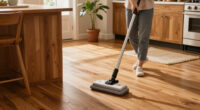
This guide helps you decide whether a steam mop is safe for your hardwood floors and, only if the floor and mop manufacturers allow it, use the mop with care. It is for homeowners and renters who want to remove everyday dirt without leaving standing moisture or harming the floor’s finish. Allow 30-60 minutes for a typical room, including preparation and drying.

Get cleaning gear delivered free with Prime
- Fast, free delivery on millions of items
- Prime Video, Amazon Music and more included
- Member-only deals all year

Shark Steam & Scrub Steam Mop – All-in-One Hard Floor Cleaner (Grey, S8001)
- ✔ Model: S8001
- ✔ Steam modes: Light, Normal, Deep
- ✔ Scrubbing rate: 150+ scrubs per minute
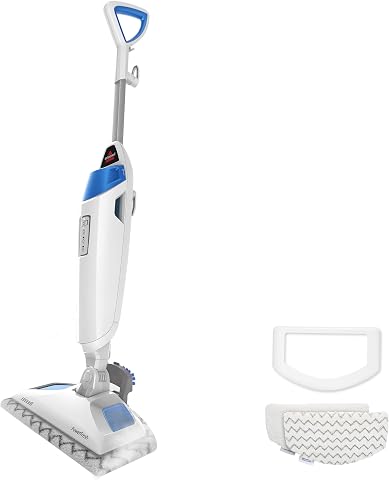
BISSELL Steam Mop 1940A PowerFresh Floor Steam Cleaner for Hard Wood & Tile
- ✔ Model: 1940A PowerFresh
- ✔ Steam settings: Three
- ✔ Power cord: 23 feet

Shark Steam Pocket Mop with 2 Washable Double-sided Pads – Purple (S3501)
- ✔ Model: S3501
- ✔ Weight: Under 5 pounds
- ✔ Heat-up time: About 30 seconds
Many hardwood manufacturers advise against steam cleaning. Heat and moisture can damage the finish, seep between boards, or cause swelling, cupping, and discoloration. The safest choice when instructions are unclear is a dry method or a wood-floor cleaner approved by the flooring manufacturer—not a test with steam.
Difficulty: Beginner | Time: 30-60 minutes, depending on floor size
What You’ll Need
Tools & Materials:
- Steam mop with a clean, intact microfiber pad
- Hardwood-floor care instructions from the flooring manufacturer
- Steam-mop manual
- Soft-bristle broom or vacuum suitable for hardwood
- Dry microfiber cloths
- Approved hardwood floor cleaner, if needed for spot cleaning
Knowledge:
- Ability to identify the floor brand or obtain care instructions from the installer, landlord, or manufacturer
- Basic familiarity with the steam mop’s water tank, settings, and controls
Check the care instructions for both the floor and steam mop before filling the tank. Use steam only if both manufacturers explicitly permit it for your specific type of hardwood and finish. A sealed appearance does not prove that the floor can tolerate steam. Do not use a steam mop on unfinished, waxed, oiled, damaged, or uncertain flooring unless its manufacturer specifically approves that use.
Keep people and pets out of the room while you work. Hot steam can burn, and the mop pad and floor head may remain hot after use.
Shark Steam & Scrub Steam Mop – All-in-One Hard Floor Cleaner (Grey, S8001)
The Shark S8001 earns our top position for households that need more than a light maintenance pass. Its rotating Dirt-Grip microfiber pads work alongside steam, giving it an active scrubbing element that the two more straightforward mops here do not match. That can make it a better fit for dried spills and tracked-in grime on manufacturer-approved, sealed hardwood, rather than relying only on heat and a manually guided pad.Three modes—Light, Normal, and Deep—let us choose a less intensive setting for routine cleaning instead of defaulting to the strongest option. That flexibility matters on wood, where following the flooring maker’s care guidance is more important than pursuing maximum steam. LED headlights may also help reveal dust and debris that are easy to miss under furniture. Compared with the BISSELL, the S8001 offers powered pad movement rather than a built-in spot scrubber; compared with the lighter S3501, it is the more assertive tool for soils that need extra agitation.The tradeoff is upkeep. Its machine-washable pads require cleaning after use, and rotating scrubbing is not automatically the best choice for every wood finish or delicate floor. We would skip it if the floor maker prohibits steam or if a simple dust-and-damp-mop routine already handles the mess. The product information also describes a removable large tank but does not give a capacity, so we would not assume a specific runtime.
Pros:
- Rotating microfiber pads add scrubbing action for stuck-on stains.
- Three steam modes support lighter and deeper cleaning tasks.
- LED headlights help show debris in dim or shadowed areas.
- Four machine-washable pads are included.
Cons:
- Pads need washing and drying as part of the cleaning routine.
- Active scrubbing may be more than delicate or steam-sensitive flooring should receive.
- The supplied specifications do not state an exact tank capacity or power-cord length.
Best for: Owners of sealed hardwood approved for steam who regularly face stuck-on spots and want adjustable modes plus powered scrubbing.
Not ideal for: People with unsealed, damaged, waxed, or steam-prohibited floors, or anyone who wants minimal pad maintenance and a gentler, simpler mop.
Bottom line: Choose the S8001 when your sealed hardwood care instructions allow steam and powered pad scrubbing is worth the extra laundry.
“Choose the S8001 when your sealed hardwood care instructions allow steam and powered pad scrubbing is worth the extra laundry.”
BISSELL Steam Mop 1940A PowerFresh Floor Steam Cleaner for Hard Wood & Tile
The BISSELL PowerFresh 1940A is our balanced pick for shoppers who want to vary the steam output and handle the occasional dried-on patch without moving up to rotating pads. Its three settings offer a choice for different cleaning tasks, while the built-in Easy Scrubber gives us a more targeted way to work on stubborn grime. That makes it more adaptable than the lightweight Shark S3501, which prioritizes maneuverability and a quick start over dedicated scrubbing features.A 12-inch cleaning path and 23-foot cord help cover ordinary rooms without frequent outlet changes. It is also described for sealed hardwood and several other hard surfaces, though hardwood owners should still verify that their own floor’s manufacturer permits steam. The removable XL tank is convenient to fill, but the stated limitation—frequent refills during larger sessions—keeps this from being our first choice for extensive floor plans. Unlike the S8001, the BISSELL does not rely on rotating pads, which may appeal to buyers who prefer to control spot scrubbing themselves.We would choose it for a home where cleaning needs vary, rather than for someone seeking the lightest mop or the most hands-off stain removal. The scent discs are optional and sold separately, so they should not factor into the basic cleaning value. Most importantly, three settings do not make steam safe for every wood surface: avoid steam on unsealed or compromised floors, and use the least intensive approach allowed by the flooring guidance.
Pros:
- Three steam settings offer more control than a single-output mop.
- Built-in Easy Scrubber helps tackle dried-on grime.
- A 23-foot cord reduces outlet changes across a room.
- 12-inch cleaning path and removable XL tank support routine floor cleaning.
Cons:
- The tank may need frequent refills during larger cleaning sessions.
- Optional Spring Breeze scent discs are sold separately.
- It lacks the rotating-pad action of the Shark S8001.
Best for: Households with approved sealed hardwood that want multiple steam levels, a long cord, and a built-in tool for occasional stubborn spots.
Not ideal for: People cleaning very large areas who dislike refilling, buyers who want rotating-pad scrubbing, or anyone whose wood-floor maker advises against steam.
Bottom line: Pick the PowerFresh for useful steam adjustment and targeted scrubbing, provided its refill routine suits the size of your home.
“Pick the PowerFresh for useful steam adjustment and targeted scrubbing, provided its refill routine suits the size of your home.”
Shark Steam Pocket Mop with 2 Washable Double-sided Pads – Purple (S3501)
For buyers who want a straightforward mop that is easy to steer and put away, the Shark S3501 stands apart from the two more scrubbing-focused choices. At under five pounds, with swivel steering and a roughly 30-second heat-up, it is the most maneuverable option in this group. Those traits can matter more than extra cleaning mechanisms when we are doing quick passes around chairs, narrow spaces, or a smaller floor area.Its double-sided microfiber pads provide two usable cleaning faces before laundering, a practical difference from the S8001’s included four separate pads and the BISSELL’s scrubber-based approach. The S3501 is also described with an XL water capacity, but the supplied information gives no exact measurement, and refilling may still be needed over a very large area. Compared with the PowerFresh, it gives up adjustable steam settings and a built-in scrubber; compared with the S8001, it lacks powered rotating pads. We see it as a convenience-first option, not the strongest choice for persistent dried-on messes.Washable pads mean ongoing laundry, and the long cord’s exact length is not specified. Its listed use includes hardwood and other hard surfaces, but that broad list should not be taken as permission to steam every wood floor. Confirm the flooring manufacturer’s rules and avoid use on unsealed, damaged, or otherwise steam-sensitive surfaces. If your floor is approved and your priority is a light tool that is ready quickly, this simpler Shark may be easier to live with than the more involved S8001.
Pros:
- Under-five-pound design is easier to carry and maneuver.
- Heats in about 30 seconds for quick cleanups.
- Double-sided washable pads provide two cleaning faces.
- Swivel steering helps navigate around furniture and tight spaces.
Cons:
- No rotating pads or dedicated built-in scrubber for stubborn stains.
- Pads require regular machine washing.
- The exact cord length and tank capacity are not specified; large areas may need refills.
Best for: People with steam-approved sealed hardwood who favor a lightweight mop, quick heat-up, and easy steering for routine cleaning.
Not ideal for: Buyers who need powered scrubbing, multiple steam modes, a stated cord length, or a maintenance-free pad system.
Bottom line: Choose the S3501 for light, nimble maintenance on approved sealed hardwood, not for the toughest messes in this comparison.
“Choose the S3501 for light, nimble maintenance on approved sealed hardwood, not for the toughest messes in this comparison.”
As an Amazon Associate we earn from qualifying purchases.
Before You Start
Read the floor instructions first; they take priority over general cleaning advice or a mop’s marketing claims. If the flooring instructions prohibit steam, or you cannot confirm that steam is allowed, do not proceed with the steam-mop steps. Sweep or vacuum, then use the manufacturer-approved cleaning method instead.
Never add floor cleaner, vinegar, fragrance, or other chemicals to the water tank unless the mop manufacturer specifically permits that product. Additives can damage the appliance or floor, and some cleaners can leave residue. Use plain water of the type recommended by the mop manual.
Step-by-Step Instructions
Step 1: Confirm steam cleaning is permitted
Find the care instructions for your exact hardwood product and read the cleaning and warranty guidance. Check the steam-mop manual for its approved floor types. Proceed only when both sets of instructions explicitly allow steam on your flooring and finish. If either source forbids it, or you cannot confirm compatibility, stop and choose a dry or manufacturer-approved damp-cleaning method instead.
Inspect the floor for open seams, loose boards, worn finish, cracks, peeling, or areas that have previously swollen or discolored. Do not steam a damaged or visibly unsealed area unless the flooring manufacturer gives clear permission for it.
Tip: A “sealed hardwood” label alone is not permission to use steam. Heat and vapor can still pass through seams or damage some finishes.
Check: You have clear approval for steam cleaning from the flooring instructions and the mop manual, and the floor has no visible damage that rules out use.
Step 2: Clear and dry-clean the floor
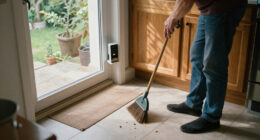
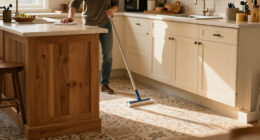
Move small furniture, rugs, cables, and objects off the area. Sweep with a soft-bristle broom or vacuum using a hardwood-safe setting and attachment. Pick up grit and crumbs before mopping; dragging debris beneath a microfiber pad can scratch the finish.
Clean sticky spots separately with the method and product approved by the flooring manufacturer. Apply cleaner to a cloth rather than pouring or spraying it onto the floor, unless the product instructions direct otherwise. Wipe up all residue and moisture before using steam.
Tip: Do not use a vacuum beater bar unless the vacuum maker confirms it is safe for your floor.
Check: The floor is free of loose grit and debris, and there are no wet patches or cleaning-product residue.
Step 3: Prepare the mop and pad
Inspect the mop, cord, tank, and pad. Replace a dirty or worn pad and do not use the appliance if its cord, plug, or body is damaged. Fit the pad as directed in the manual. Fill the tank with the water type and amount specified by the mop manufacturer, then attach the tank securely.
Select the lowest steam setting that the manufacturer permits for hardwood. If the manual requires preheating, do so with the mop positioned on its stand or another heat-safe surface, not left steaming in one spot on the wood. Keep the mop upright and avoid touching the hot pad or steam outlet.
Tip: Do not fill the tank with cleaner or other additives unless the mop manual explicitly allows them.
Check: The mop is assembled correctly, the pad is clean and attached, and the selected setting matches the instructions for approved hardwood use.
Step 4: Test a discreet area
Choose a small, inconspicuous section of the floor, such as behind a door, that is representative of the surface you plan to clean. Pass the mop over it once, following the mop manual’s operating directions and keeping it moving. Do not pause, scrub repeatedly, or direct steam at seams.
Wipe the test area dry with a clean microfiber cloth. Check it immediately for water, haze, color change, or a softened or tacky feel. Check again after it has dried for the length of time recommended by the flooring manufacturer. Stop if you notice any change.
Tip: A spot test can reveal an obvious problem, but it cannot guarantee that repeated steam cleaning will be harmless.
Check: The test area dries without visible moisture, discoloration, haze, tackiness, or change in the finish.
Step 5: Clean in short, steady passes
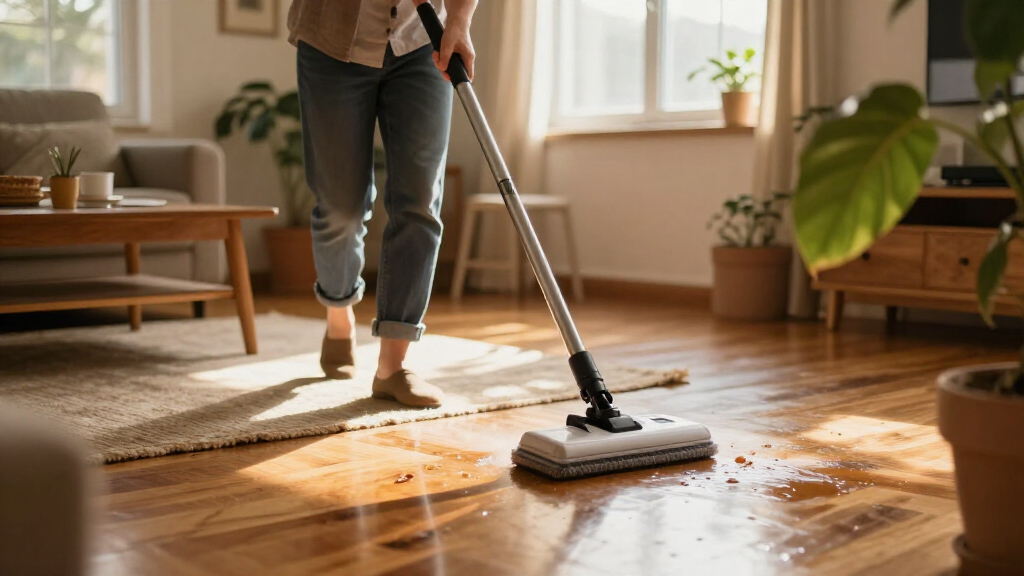
Work in a small section at a time, guiding the mop continuously in smooth passes. Follow the mop manual for direction and speed; never leave a steaming mop stationary on the floor. Use only the lowest approved steam setting, and do not make repeated passes over one spot to force away a stain.
Keep the pad flat and clean. Change or rinse it as directed by the mop manufacturer when it becomes dirty; a saturated or grimy pad can spread soil and leave excess moisture behind. Avoid pushing the mop into open joints, damaged edges, or seams. Stop at once if you see water beading, pooling, or collecting along board edges.
Tip: Use a dry microfiber cloth for stubborn dirt rather than increasing steam or dwelling on the spot.
Check: The cleaned area looks free of loose dirt, with no visible puddles, wet seams, or cloudy residue.
Step 6: Dry and inspect the floor
As soon as you finish each section, check for damp areas and wipe them with a clean, dry microfiber cloth. Allow the room to air-dry with good ventilation, and keep foot traffic off the floor until it is completely dry. Do not use a heater or direct hot airflow to speed drying unless the flooring manufacturer recommends it.
Inspect the boards and seams in good light, both shortly after cleaning and once dry. Stop using steam if you notice swelling, raised edges, gaps, a change in color, a cloudy finish, or a persistent damp smell. Contact the flooring manufacturer or a qualified flooring professional if any change appears.
Tip: Do not put rugs or furniture back until the floor and any cleaning residue are fully dry.
Check: The floor is dry to the touch, the joints have no trapped moisture, and the finish looks and feels unchanged.
Step 7: Switch off and clean the mop
Turn off and unplug the mop. Let it cool in the position specified by its manual before removing the pad or emptying the tank. Wash or discard the pad according to its care label, and dry it fully before storage. Empty and clean the tank only as directed by the mop manufacturer; do not store the appliance with a wet pad attached unless the manual says that is safe.
Tip: Keep the hot mop and pad away from children, pets, and surfaces that could be damaged by heat or moisture.
Check: The appliance is unplugged and cool, the used pad is removed, and the mop is stored according to its manual.
Common Mistakes to Avoid
- Putting cleaner or vinegar into the water tank. — Use only the water and additives expressly allowed by the mop manufacturer. Apply approved floor cleaner separately as its label directs.
Troubleshooting
Problem: Water beads, pools, or gathers in the seams during cleaning.
Solution: Stop immediately and switch off the mop. Blot the moisture with a dry microfiber cloth and let the floor dry with ventilation. Do not resume until you have confirmed that steam is approved and identified why excess moisture appeared; contact the flooring manufacturer if moisture entered the joints.
Problem: The floor looks cloudy, feels tacky, or changes color after a pass.
Solution: Stop steam cleaning. Do not add more heat or cleaner to the affected area. Blot any moisture, allow the floor to dry, and ask the flooring manufacturer or a qualified floor professional which recovery method is safe.
Problem: The mop leaves streaks or spreads dirt.
Solution: Turn off the mop and check whether the pad is dirty, over-wet, or worn. Replace it with a clean pad and verify that you have removed loose grit and cleaner residue. If streaking continues, stop and use the flooring maker’s recommended non-steam method.
Problem: The mop produces little or no steam.
Solution: Unplug it and let it cool before checking the tank level, tank fit, and settings according to the manual. Use the specified water type and follow the stated warm-up time. Do not open, descale, or repair the appliance while it is hot or plugged in.
What Success Looks Like
The task is complete when the floor is visibly free of loose dirt, completely dry, and unchanged in appearance and feel. There should be no standing water, damp seams, haze, tackiness, swelling, discoloration, or new gaps. The mop should be switched off, cool, and stored with its pad cleaned or removed as directed by its manual.
If the floor’s instructions do not approve steam, success means stopping before steaming and cleaning with the manufacturer-approved alternative. Avoiding floor damage matters more than using a particular appliance.
Next Steps
Follow the flooring manufacturer’s schedule and method for routine cleaning. Sweep or vacuum regularly to remove grit, and use an approved wood-floor cleaner for spills and sticky spots. Do not repeat steam cleaning unless the floor maker permits it; if that permission is conditional, follow its stated frequency and technique exactly.
Keep the floor-care instructions and steam-mop manual available for future cleaning. If you see swelling, finish damage, or persistent moisture, stop cleaning the area and contact the flooring manufacturer, installer, landlord, or a qualified flooring professional.
Frequently Asked Questions
Can I use a steam mop on any hardwood floor?
No. Hardwood products and finishes differ, and many manufacturers advise against steam. Use it only when the instructions for both your exact floor and your mop explicitly allow it. If you cannot verify that, choose the approved non-steam method.
Does a sealed hardwood finish make steam cleaning safe?
Not by itself. A sealed surface may still have seams or vulnerable areas, and heat or vapor can affect some finishes and boards. Check the flooring maker’s care instructions rather than relying on appearance or a general product claim.
What water should I put in a steam mop?
Use the type of water stated in the mop manual. Some appliances call for distilled or demineralized water, while others permit tap water. Do not add vinegar, floor cleaner, essential oils, or fragrance unless the manual specifically approves the product.
What should I do if the floor gets wet during steaming?
Stop and switch off the mop, then blot visible moisture with a dry microfiber cloth. Let the area dry with ventilation and check the boards and joints. Do not continue if water is entering seams or if the finish changes; ask the flooring manufacturer or a floor professional for guidance.
Columbus Day / Indigenous Peoples' Day Picks
long weekend sales
As an affiliate, we earn on qualifying purchases.