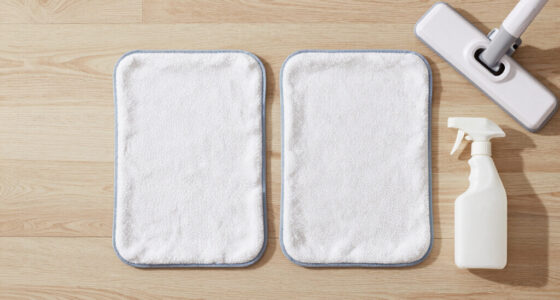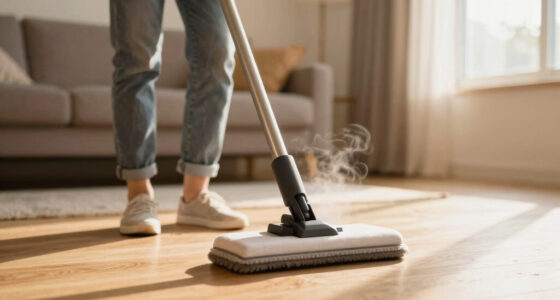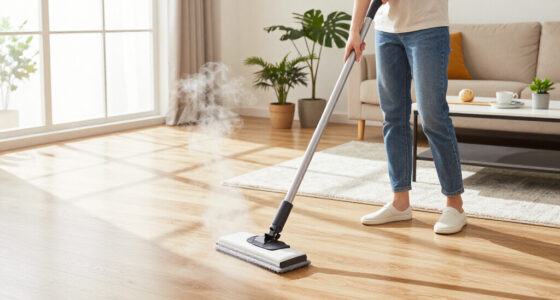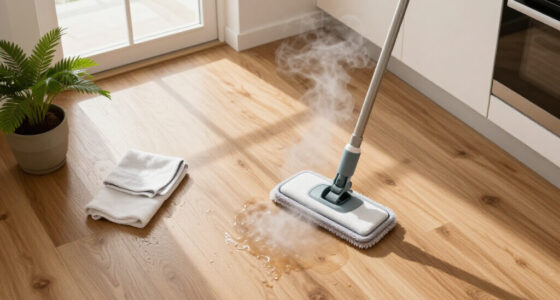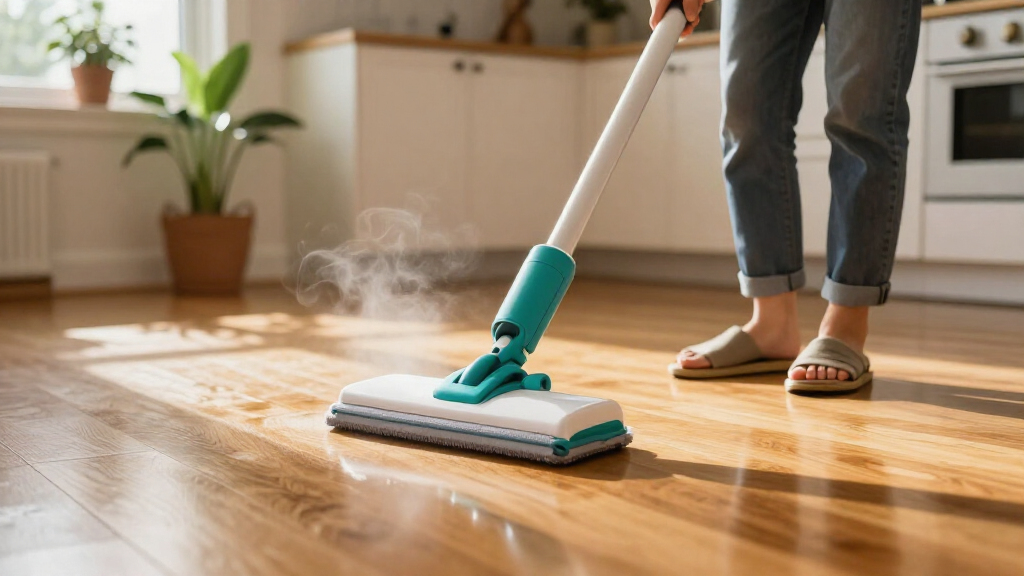

When shopping for a hard floor mop, the real choice is whether heat and reduced reliance on cleaning chemicals are worth the extra limits and upkeep of a steam mop. A steam mop heats water and releases vapor through a cleaning pad; a spray mop puts cleaning solution or water onto the floor through a trigger or reservoir. Both can handle routine dirt on suitable sealed floors, but they suit different homes. Choose steam when you want heat-assisted cleaning on compatible, sealed surfaces and can follow the manufacturer’s floor guidance. Choose a spray mop if quick pickup, lighter equipment, and control over the cleaning liquid matter more. Floor compatibility is the first test: neither mop should be used on a surface unless its maker says the method is safe.

Get cleaning gear delivered free with Prime
- Fast, free delivery on millions of items
- Prime Video, Amazon Music and more included
- Member-only deals all year

Shark Steam & Scrub Hard Floor Steam Mop – Teal (S8002BRN)
- ✔ Steam modes: 2
- ✔ Pad system: Two washable Dirt Grip Soft Scrub pads
- ✔ Tank capacity: 11.83 fluid ounces
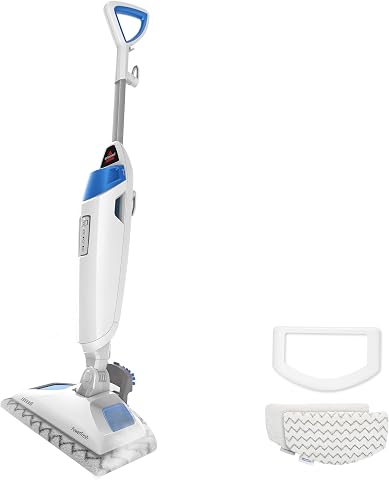
BISSELL PowerFresh 1940A Steam Mop
- ✔ Steam settings: 3
- ✔ Tank capacity: 16 fluid ounces
- ✔ Power cord: 23 feet

Shark Steam Mop for Sealed Hard Floors with 2 Dirt Grip Pads (White, S1000)
- ✔ Weight: 4.6 pounds
- ✔ Heat-up time: 30 seconds
- ✔ Tank capacity: 12.68 fluid ounces
At a Glance
| Criteria | Steam mops | Spray mops | Winner |
|---|---|---|---|
| Cleaning method | Heats water and delivers steam through a reusable pad | Applies water or floor cleaner through a manual or built-in spray | Depends |
| Routine cleaning performance | Good for everyday soil on compatible sealed floors; the pad still has to collect loosened dirt | Effective for ordinary spills and dust when paired with a suitable pad and cleaner | Tie |
| Heat and sanitizing claims | Heat may reduce some germs under specified conditions; results depend on the model, contact time and surface | No heat-based sanitizing; cleaning depends on the chosen solution and its directions | A |
| Floor compatibility | Restricted to surfaces approved by the manufacturer; moisture and heat can damage some floors | Often usable on a wider range of surfaces when the liquid and floor-care instructions are compatible | B |
| Speed and ease of use | Needs time to heat and access to power, but cleans without mixing a solution | Usually ready immediately and does not need to warm up | B |
| Upkeep and consumables | Requires water, washable pads and occasional descaling or other model-specific care | Requires pad washing and refilling; some models use proprietary or disposable pads | B |
| Value | Can suit frequent use where steam’s benefits justify a higher purchase price | Often costs less upfront; ongoing solution or pad costs vary by model | B |
Shark Steam & Scrub Hard Floor Steam Mop – Teal (S8002BRN)
The Shark Steam & Scrub S8002BRN is the most distinctive pick here because it pairs steam with rotating pads. That active scrubbing gives it a clearer role than a basic steam mop when sealed floors have dried spills or marks that need more than a light pass. It has two steam modes, swivel steering, and a removable tank, giving us a useful balance of stain-focused cleaning and room-to-room handling.Compared with the BISSELL PowerFresh, Shark’s main advantage is the rotating two-pad action; BISSELL instead offers three steam settings, a larger stated tank, and a longer cord. The S8002BRN’s 11.83-ounce tank is smaller than both competitors’ listed capacities, so larger floor areas may mean pausing to refill. It is also heavier than the S1000, and the scrub pads need regular washing. This makes the model a strong match for targeted scrubbing, but less compelling if low weight or long uninterrupted runs matter most.We would choose it for sealed floors where stuck-on spots are a recurring nuisance and the rotating pads justify extra upkeep. Shoppers looking for the simplest lightweight mop should compare it with the 4.6-pound S1000; those who prioritize reach and selectable steam intensity should look at BISSELL. Use only on flooring whose manufacturer permits steam cleaning.
Pros:
- Rotating pads add active scrubbing for stuck-on spots.
- Two steam modes let users choose between cleaning approaches.
- Removable tank supports replenishing the water between sessions.
- Swivel steering and a 6.9-pound body help navigate furniture.
Cons:
- The 11.83-ounce tank is smaller than the listed tanks on the other two models.
- Reusable scrub pads need regular washing.
- Sealed hard floors only; it is not intended for carpets or rugs.
Best for: Households with sealed hard floors and recurring dried spills or marks that benefit from rotating-pad scrubbing.
Not ideal for: Anyone who needs a carpet or rug cleaner, wants the lightest model, or prefers to avoid washing reusable pads.
Bottom line: Choose the S8002BRN when rotating-pad scrubbing matters more than the lighter weight and longer reach offered by its rivals.
“Choose the S8002BRN when rotating-pad scrubbing matters more than the lighter weight and longer reach offered by its rivals.”
BISSELL PowerFresh 1940A Steam Mop
The BISSELL PowerFresh 1940A earns its place by giving buyers more control over a cleaning session: it has three steam settings, a flip-down scrubber for dried-on messes and grout, and the longest cord in the lineup at 23 feet. Its 16-ounce removable tank is also the largest listed here. Together, those details suit a user who wants to cover more floor before needing to refill or switch outlets, with the option to adjust steam for different cleaning needs.Against the Shark S8002BRN, BISSELL trades rotating pads for a flip-down scrubber. That means it has a targeted tool for stubborn areas rather than continuous powered pad rotation. It also weighs 6.2 pounds, less than the S8002BRN but more than the 4.6-pound Shark S1000. The 30-second heat-up matches the S1000, while the extra steam setting may appeal to users who value adjustment over the S1000’s straightforward, light-duty approach.We would pick this model for larger sealed-floor routes where cord reach, tank capacity, and selectable steam are useful together. The cord still ties cleaning to an outlet, and this is not a multipurpose carpet cleaner. If scrubbing action is the deciding factor, Shark’s rotating pads make a different case; if carrying weight is the priority, the S1000 is the easier lift.
Pros:
- Three steam settings provide more adjustment than either Shark model.
- The 16-ounce removable tank is the largest listed in this group.
- A 23-foot cord offers the longest reach in this comparison.
- Flip-down scrubber targets dried-on messes and grout.
Cons:
- The cord requires an accessible outlet and can constrain the cleaning route.
- At 6.2 pounds, it is heavier than the Shark S1000.
- It is designed for sealed hard floors, not carpet or rugs.
Best for: People cleaning larger areas of approved sealed flooring who value a long cord, a larger tank, and three steam settings.
Not ideal for: Buyers who want cordless operation, a lightweight body, or rotating pads for continuous scrubbing.
Bottom line: Pick the PowerFresh when extended reach and steam adjustment matter more than minimum weight or rotating-pad action.
“Pick the PowerFresh when extended reach and steam adjustment matter more than minimum weight or rotating-pad action.”
Shark Steam Mop for Sealed Hard Floors with 2 Dirt Grip Pads (White, S1000)
The Shark S1000 is the straightforward choice for shoppers who want a lightweight steam mop without extra scrubbing mechanisms. At 4.6 pounds, it is the easiest model here to carry between rooms or lift for storage. Its 30-second heat-up and swivel steering also suit shorter, spontaneous cleaning passes. The two machine-washable Dirt Grip pads can be reused, though they still need routine laundering.Compared with the S8002BRN, this Shark gives up rotating pads and the more stain-focused design in favor of a lighter body. Against the BISSELL PowerFresh, it has a smaller listed tank and shorter 18-foot cord, but the simpler, lighter setup may matter more in a compact home or for quick cleanups. Its 12.68-ounce capacity sits between the other two models, so it does not lead on session length.This model makes the most sense when easy handling is the main criterion and the floor area is modest enough that refilling is not a major inconvenience. For stubborn marks, the rotating-pad Shark is better equipped; for broader routes and more steam settings, BISSELL has the edge. Like both alternatives, the S1000 is intended only for sealed hard floors, and steam compatibility should be verified for the specific floor finish.
Pros:
- At 4.6 pounds, it is the lightest model in the comparison.
- Heats up in 30 seconds for quick cleaning sessions.
- Swivel steering and an 18-foot cord support room navigation.
- Includes two machine-washable microfiber pads.
Cons:
- Its tank is smaller than BISSELL’s 16-ounce capacity.
- It does not have rotating pads or a flip-down scrubber for targeted scrubbing.
- It is suitable for sealed hard floors only.
Best for: People who want an easy-to-carry mop for quick cleaning passes on approved sealed hard floors.
Not ideal for: Those tackling frequent stuck-on stains, cleaning broad areas between refills, or needing the longest cord.
Bottom line: Choose the S1000 for light weight and quick starts, while accepting less scrubbing help and shorter reach than the other picks.
“Choose the S1000 for light weight and quick starts, while accepting less scrubbing help and shorter reach than the other picks.”
As an Amazon Associate we earn from qualifying purchases.
Key Differences
The biggest practical divide is heat versus control. Steam mops avoid routinely dispensing detergent and can loosen grime with heat, but a user must verify that the floor tolerates both heat and moisture. A spray mop lets the user choose water or an appropriate cleaner and apply small amounts where needed. That flexibility makes it the safer general-purpose pick for households with mixed flooring, provided the cleaner is suitable for each surface.
Neither tool removes the need for good technique. A dirty pad can spread soil, excess liquid can harm sensitive floors, and a steam mop’s sanitizing claims are not a substitute for disinfecting directions. Steam is a specialized option for compatible sealed floors and people who value heat-assisted cleaning. For most quick, routine hard-floor jobs, spray mops are easier to start, store and adapt.
Detailed Comparison
Cleaning method (moderate difference)
Steam mops heat water and pass vapor through a pad; spray mops wet the floor with water or cleaning solution. Neither method automatically cleans better: the pad, soil level and movement across the floor matter. This is a moderate difference because it changes how the mop works and which surfaces can tolerate it. Steam wins if avoiding regular detergent use is a priority; spray wins if choosing the liquid matters.
Routine cleaning performance (minor difference)
On manufacturer-approved sealed floors, both can pick up ordinary dust, footprints and light spills. Steam can help loosen dried residue, while a spray mop can target a sticky mark with a suitable cleaner. Neither replaces sweeping or vacuuming first, and both depend on a clean pad. The gap is minor for everyday maintenance, so there is no universal winner.
Heat and sanitizing claims (Steam mops wins — major)
Steam has the advantage when heat is useful, but sanitizing results depend on the machine, temperature at the floor, dwell time and surface. A quick pass should not be assumed to disinfect. Spray mops do not provide heat-based germ reduction, though a compatible disinfecting product may be used when its label permits floor application and specifies the required contact time. This is a major distinction for buyers seeking heat, but it is not a guarantee of sterilization.
Floor compatibility (Spray mops wins — major)
Spray mops generally offer more control because users can apply a small amount of an approved cleaner or water. Steam mops combine moisture and heat, which can harm certain finishes, unsealed wood, waxed surfaces, or floors whose manufacturer prohibits steam. Check the flooring and mop instructions before use; labels such as “hard floor” are not enough. This is a major practical advantage for spray mops in homes with mixed materials.
Speed and ease of use (Spray mops wins — moderate)
A spray mop is typically ready when its reservoir is filled, while a steam mop needs an outlet and a warm-up period. Spray models can be convenient for a small spill or a quick pass through the kitchen. Steam models avoid measuring or spraying cleaner, but their cord, water tank and warm-up add steps. The moderate advantage goes to spray for frequent short jobs.
Upkeep and consumables (Spray mops wins — minor)
Both require laundering or replacing pads and emptying or refilling a reservoir. Steam models may also need descaling or care suited to their heating system, and some restrict which water can be used. Spray models can require recurring floor cleaner or proprietary pads, although reusable pads and compatible refill solutions can reduce that cost. Spray has a modest edge for simpler maintenance; check refill and pad availability before buying.
Value (Spray mops wins — moderate)
Spray mops usually have a lower entry price and cover more routine situations, which makes them better value for many households. Paying more for steam makes sense when the floor is approved for steam and the user expects to use its heat-assisted method often. A higher price alone does not mean better cleaning or safer floor care. This is a moderate spray-mop win for general value, with steam worthwhile for a narrower buyer.
Steam mops: Pros and Cons
Pros:
- Uses heated water rather than routinely dispensing floor cleaner
- Can loosen grime on compatible sealed floors
- May reduce some germs when the model’s stated conditions are met
Cons:
- Heat and moisture make floor compatibility a significant concern
- Requires power, warm-up time and model-specific care
- Sanitizing performance should not be assumed from a quick pass
Spray mops: Pros and Cons
Pros:
- Usually ready for quick cleanups without a warm-up
- Lets users select an appropriate cleaner or water
- Typically costs less upfront and adapts to more everyday tasks
Cons:
- Does not provide heat-based germ reduction
- May create ongoing solution or pad expenses
- Can leave residue or damage floors if the wrong cleaner or too much liquid is used
Who Should Choose What
Choose Steam mops if:
- Your flooring manufacturer approves steam and you want heat-assisted cleaning on those sealed floors.
- You prefer not to apply cleaning solution during routine mopping and will follow the steam mop’s care instructions.
Choose Spray mops if:
- You want a mop for quick spills and routine cleaning without waiting for it to heat.
- Your home has multiple hard-floor types and you need control over the liquid used on each.
- You want a lower-cost, adaptable option and do not need steam’s heat-based feature.
Skip both if: Your flooring manufacturer prohibits both steam and damp cleaning, or the floor needs a specialist care method; follow its maintenance guidance instead.
Value for Money
For most households, a spray mop is the stronger value because it handles routine jobs with fewer setup steps and typically costs less to buy. Its value depends on pad durability and whether it takes standard refills or proprietary supplies. Paying more for a steam mop is worthwhile when you have compatible flooring, expect to use it regularly, and value cleaning with heated water. It is poor value if your floors cannot safely take steam or if most jobs are small spills that a spray mop handles faster.
Final Verdict
Choose a spray mop as the default for everyday hard-floor care: it starts quickly, gives you control over moisture and cleaner, and usually costs less. Choose a steam mop when your floor maker explicitly approves steam and heat-assisted cleaning is a feature you will use often. The biggest deciding factor is floor compatibility, followed by whether you value heat enough to accept the extra setup and upkeep. If your flooring rules out steam, the spray mop is the clear choice.
Frequently Asked Questions
Are steam mops safe for every hard floor?
No. Heat and moisture can damage some finishes and materials. Check both the flooring manufacturer’s care instructions and the steam mop’s approved-surface list before use.
Does a steam mop disinfect a floor?
It may reduce some germs under specific temperature and contact-time conditions, but results vary by model and surface. Follow the manufacturer’s claims and directions; do not treat a quick pass as guaranteed disinfection.
Can I put floor cleaner in a steam mop?
Only if the manufacturer explicitly permits it. Many models are designed for water alone, and adding cleaner can damage the unit or leave residue.
Which mop is better for mixed flooring?
A spray mop is generally more adaptable because you can use a small amount of a compatible liquid for each surface. Confirm that both the mop and cleaning product are approved for the floor.