TL;DR
Open a free Amazon Business account
Business pricing, bulk buying and tax-exempt orders.
Create a free accountAs an affiliate, we earn on qualifying purchases.
Steam doesn’t dissolve grease chemically; it softens and loosens residues via heat, moisture, and pressure. Wiping or extraction then clears the grime. It works best on softer, water-soluble deposits and with proper technique.
Imagine a thick layer of baked-on grease on your oven’s interior. Scrubbing feels futile, and chemical cleaners seem harsh or ineffective. Steam, however, can be a surprisingly gentle yet powerful ally. It doesn’t just clean — it transforms stubborn grime into manageable messes.
If you’ve ever wondered how steam can loosen years of kitchen buildup, this guide unpacks the science in plain language. You’ll learn how heat, moisture, and pressure work together to soften and lift grease and baked-on deposits. Plus, you’ll get practical tips on using steam safely and effectively on different surfaces. Ready to turn steaming from a vague idea into your go-to cleaning tool?
Steam softens grease and baked-on residues by rapidly transferring heat through condensation.
Pre-clean loose debris and work in small sections for best results.
Immediate wiping with a microfiber cloth captures loosened grime before it resettles.
Old, polymerized grease may resist steam and need brushing or chemical help.
Always test surfaces first and follow safety guidelines to avoid damage or injury.
The physics of a cleaner surface
How Steam Loosens Grease and Baked-On Grime
Steam does not chemically dissolve grease. It delivers heat, moisture, and focused force that soften deposits, weaken adhesion, and prepare the mess for wiping, brushing, or extraction.
Lowers grease viscosity.
Rehydrates dried residue.
Dislodges weakened soil.
Captures mobilized grime.
Five mechanisms
What happens at the surface
The visible vapor is only the delivery system. Cleaning begins when its energy and moisture interact with the deposit and the cooler material beneath it.
Grease becomes more fluid
Rising temperature lowers viscosity, turning a hard or sticky fat layer into a softer film that is easier to move.
Dried soil rehydrates
Condensed water penetrates pores and seams, softening food, starches, sugars, and other water-soluble deposits.
Adhesion weakens
Grime and its underlying surface may expand at different rates, creating small stresses along their shared boundary.
Edges begin to lift
A concentrated jet pushes into corners, seams, and textures, mechanically disturbing residue already softened by heat.
Energy releases rapidly
Vapor changing into liquid on a cooler surface transfers substantial heat quickly, accelerating the softening process.
Best-practice workflow
Steam, dwell, agitate, capture
Steam mobilizes soil; it rarely carries everything away. Immediate removal is what converts loosened residue into a genuinely clean surface.
Clear debris
Remove crumbs and loose dirt first.
Test a small area
Confirm heat and moisture compatibility.
Use short passes
Work in small, controlled sections.
Allow brief dwell
Give heat time to soften the deposit.
Agitate safely
Brush stubborn texture without scratching.
Wipe immediately
Trap grime with clean microfiber.
Why the final wipe matters
If condensed water and loosened grease remain on the surface, the soil can spread, cool, and settle again. Fold the cloth often and repeat with a clean section; extraction-capable machines can collect some residue directly.
Resistance spectrum
Not all grime responds equally
The older and more chemically altered the deposit, the less likely steam alone will finish the job. These bars show relative responsiveness, not laboratory removal rates.
Fresh grease
Heat quickly makes recent fats softer and more mobile.
Polymerized oil
Repeated heat and oxygen create a tough, varnish-like film.
Carbonized soil
Fully charred matter resists water; steam mainly loosens edges.
Relative steam responsiveness
Conceptual guide based on deposit type and the mechanisms steam can act upon.
Method comparison
Choose the action the soil needs
Pressure is only one variable. Effective cleaning depends on temperature, condensation, dwell time, contact, agitation, and removal.
| Deposit | Steam alone | Useful follow-up | Main limitation | Practical verdict |
|---|---|---|---|---|
| Fresh grease | ✓ Strong | Immediate microfiber wipe | May smear if not captured | ✓ Excellent fit |
| Dried sauce or sugar | ✓ Strong | Brief dwell and soft brush | Over-saturation around seams | ✓ Excellent fit |
| Old polymerized oil | ~ Partial | Repeated passes or degreaser | Cross-linked varnish-like film | ~ Combined method |
| Carbonized residue | ✗ Weak | Surface-safe scraper or brush | Char is not water-soluble | ✗ Steam is support only |
Safety and compatibility
Powerful heat requires restraint
Test an inconspicuous area, follow both manufacturers’ instructions, and stop if a surface changes color, texture, shape, or adhesion.
Keep the jet away from life
Never direct steam at skin, people, pets, or pressurized containers. Hot vapor and condensate can cause severe burns.
Do not steam a hot oven
Sudden temperature changes can damage glass, enamel, coatings, seals, and appliance components.
Unplug and keep controls dry
Avoid outlets and live components. Let surfaces dry fully before reconnecting power where appropriate.
Heat and moisture can migrate
Unsealed wood, wax, laminates, adhesives, paint, delicate plastics, and cracked materials may be harmed.
Visible vapor is not proof
Sanitizing depends on tested surface temperature, exposure time, contact, and the machine’s verified performance.
Ventilate the workspace
Heating old grease can release odors and airborne compounds, especially around heavily soiled cooking equipment.
Use extra care around
The takeaway
Soften first. Remove second.
Steam transforms stubborn grime into a manageable mess—it does not make the mess disappear. Use controlled heat and moisture to weaken the deposit, add safe agitation where needed, then wipe or extract immediately before residue can resettle.
How Steam Softens and Loosens Grease Quickly and Safely
Steam cleaning works by applying intense heat, moisture penetration, and mechanical force to grime. When you expose greasy surfaces to hot vapor, the heat causes the fats and oils to soften and become more fluid. This process is like warming butter until it melts — only on a microscopic level.
Meanwhile, the moisture from the vapor seeps into tiny pores, cracks, and surface textures. As the vapor condenses back into water, it rehydrates dried food, sugar residues, and stubborn fats. Think of it as rehydrating a dried sponge, making it easier to squeeze out the dirt.
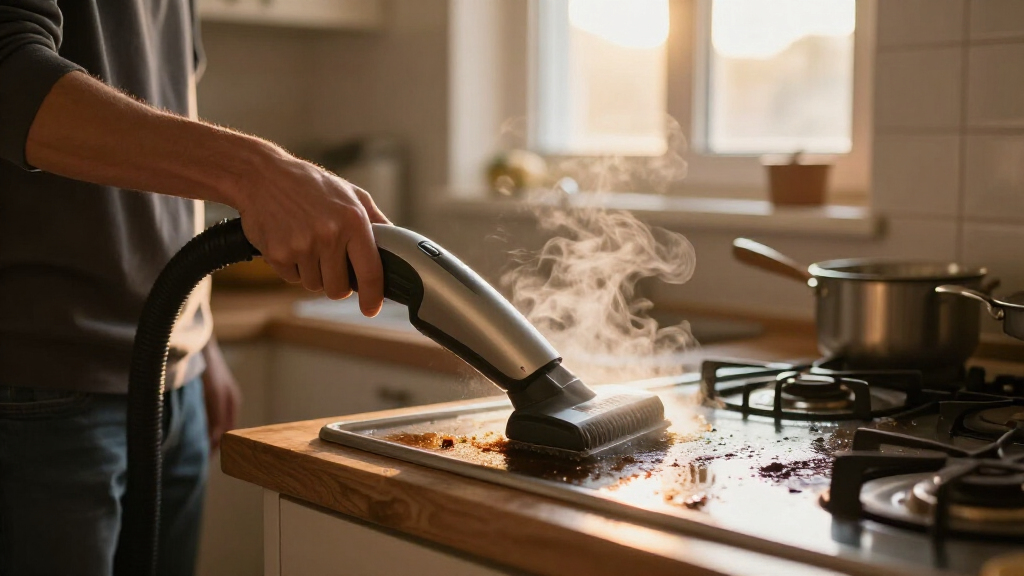
For example, a kitchen stovetop caked with greasy buildup can often be loosened in just a few passes of hot steam, especially if you follow up with a microfiber cloth. The heat reduces the grease’s viscosity, turning hardened stains into a semi-liquid state that’s ready to be wiped away.
Understanding this process is crucial because it highlights the importance of temperature control and timing. Too little heat or too short a treatment might not soften the grease sufficiently, leading to ineffective cleaning. Conversely, excessive heat or prolonged exposure can damage delicate surfaces or cause burns. Therefore, recognizing the mechanisms helps in choosing the right approach for each surface, balancing effectiveness with safety.
As an affiliate, we earn on qualifying purchases.
Why Heat Makes Grease Easier to Remove — No Chemistry Needed
Heat reduces the viscosity of grease, making it flow like a sticky syrup. When cooking fats hit around 130°F (54°C), they start to soften. At 212°F (100°C), they become even more fluid, which explains why hot steam can make stubborn, hardened deposits more manageable.
Imagine a frying pan with dried oil. Drench it in steam, and the oil begins to shimmer, loosen, and lift away. This isn’t magic — it’s basic physics. The thermal energy disrupts the bonds holding the fats together and to the surface.
But it’s important to recognize that not all grease responds equally. Older, polymerized, or carbonized deposits have undergone chemical transformations over time, creating a more resistant, varnish-like layer. These layers are cross-linked and often chemically bonded to the surface, making them harder to soften purely with heat. While steam can loosen the surface, it might not fully remove these older deposits without additional mechanical action or chemical aid. This highlights a tradeoff: the more stubborn the deposit, the more aggressive or combined methods you might need, which impacts safety and surface integrity. Knowing this helps in managing expectations and choosing appropriate cleaning strategies, avoiding damage or incomplete cleaning.
As an affiliate, we earn on qualifying purchases.
Moisture Penetrates Deep — Making Embedded Grime Easier to Lift
Steam’s moisture reaches into tiny crevices, corners, and textured surfaces where traditional scrubbing often misses. Once the vapor condenses into water, it rehydrates embedded particles like dried food, sugars, and oils. Think of it as softening hardened glue so you can peel it away more easily.
For instance, a baked-on casserole dish with stubborn sauce splatters can often be loosened by a few minutes of steaming, especially if you target the edges and seams first. The condensed water helps rehydrate dried residues, making them less likely to smear or spread when wiped.
This penetration isn’t just about cleaning surface grime; it’s about breaking the bonds that keep deposits stuck in microscopic nooks, turning what once seemed impossible to clean into a manageable task. This process is particularly valuable for textured surfaces or areas with complex shapes, where traditional cleaning tools struggle to reach. It means that even the most embedded residues can be loosened without aggressive scrubbing, reducing the risk of surface damage and making cleaning more efficient overall.
As an affiliate, we earn on qualifying purchases.
How Mechanical Force Boosts Steam’s Cleaning Power
The concentrated steam jet supplies a gentle yet focused mechanical force. It’s like a tiny, high-pressure water gun that softens and lifts grime from corners, seams, and textured surfaces. When combined with brushing or wiping, it becomes a powerful duo.
Imagine using a microfiber cloth to wipe away loosened grease. The steam has already softened the deposit, and the cloth then absorbs and traps it. For tougher spots, a stiff brush or a scraper can dislodge residues that stubbornly cling, especially on textured tiles or oven surfaces.
This mechanical action is crucial because it physically dislodges and lifts residues that are otherwise bound tightly to surfaces. The steam’s role is to weaken these bonds, making the residues more susceptible to removal by physical means. Without this combination, steam alone might not be sufficient for stubborn or heavily baked deposits. Recognizing this synergy helps in planning effective cleaning sessions and choosing appropriate tools for different surfaces, ensuring thorough removal while minimizing risk of damage.
portable steam cleaner for appliances
As an affiliate, we earn on qualifying purchases.
As an affiliate, we earn on qualifying purchases.
Condensation: The Secret to Rapid Heating and Loosening
Condensation is the key to why steam works so fast. When the vapor hits a cooler surface, it rapidly turns into water, releasing a lot of heat in the process. This sudden transfer of energy helps soften baked-on grime and oxidized oils quickly.
Imagine steam as tiny, invisible sparks of heat that jump from vapor to surface. The quick change from vapor to liquid delivers a thermal punch, loosening residues that might otherwise require scrubbing or chemical cleaners. This rapid heat transfer is why steaming can be so effective in a short period—targeted application delivers immediate energy, breaking down tough deposits before they have a chance to set further or damage the surface.
This process also underscores the importance of timing and surface temperature. Surfaces that are already warm or cooled quickly will respond differently, which is why pre-heating or pre-cooling surfaces can influence results. Proper understanding of condensation’s role allows you to optimize your technique, ensuring maximum softening with minimal risk of surface damage or burns.
Old Grease and Baked-on Grime: Why They Resist Steam Alone
Fresh grease responds well to heat and moisture, softening quickly. But old, polymerized, or carbonized deposits form a hard, varnish-like layer that even steam struggles to dissolve fully. These deposits have been exposed to oxygen and heat over time, transforming into a stubborn film.
Imagine old, hardened syrup that has cooled and solidified. Steam may soften the edges or loosen the surface, but heavy buildup often calls for extra help — like brushing, scraping, or chemical degreasers designed for baked-on grime. This layered complexity means that relying solely on steam can lead to incomplete cleaning, leaving residues that may continue to cause problems or surface deterioration if not addressed properly. Recognizing the nature of these deposits is essential for planning an effective cleaning strategy, combining multiple methods to achieve a thorough result without risking damage or prolonged effort.
Why Wiping Immediately After Steaming Matters
Steam mobilizes dirt, but it doesn’t automatically remove it. If you leave the loosened grease behind, it can smear or resettle. Wiping immediately with an absorbent microfiber cloth captures the softened residue before it has a chance to spread.
For example, after steaming a greasy stovetop, a quick wipe with a clean cloth picks up the loosened oils and food particles. Repeating this process ensures no oily film reappears, maintaining a clean surface. Waiting too long allows the residue to cool and re-harden or resettle, making subsequent cleaning more difficult and potentially requiring reapplication of steam or chemical cleaners. Immediate wiping not only improves efficiency but also reduces the need for aggressive scrubbing, preserving surface integrity and preventing re-soiling. This step is critical for ensuring that the benefits of steaming translate into a truly cleaner, residue-free surface.
Safety First: Limitations and Precautions with Steam
Steam is powerful, but it’s not a magic wand. It’s not a universal degreaser, and improper use can cause damage or injuries. Always follow the manufacturer’s instructions and test in a small, hidden area first.
Never direct steam at electrical outlets, cords, or sensitive electronics. Keep it away from unsealed wood, painted surfaces, or porous materials that could absorb moisture or crack from rapid temperature changes. Overexposure to steam can also lead to warping or deterioration of certain materials, so understanding surface compatibility is vital.
Always unplug appliances before steaming, wear protective gloves, and allow surfaces to dry fully before reconnecting power. Remember: a scalding jet of steam can cause serious burns. Recognizing these limitations ensures you use steam safely and effectively, preventing accidents and surface damage. It’s about respecting the power of steam and understanding when and where it’s appropriate to use.
Latest Trends in Steam Cleaning for Tough Residues
Modern steam cleaners now focus more on controlling and collecting loosened dirt rather than just generating hotter steam. Features like adjustable steam output, vacuum integration, and specialized attachments make tackling baked-on grime safer and more effective.
Some machines use “dry vapor” systems that deliver high-temperature steam with minimal water, reducing moisture damage. Others combine steam with vacuum suction to remove loosened debris in one pass.
For example, a steam-and-vacuum combo can clean a heavily soiled tile grout in a kitchen or bathroom, pulling out dirt that traditional methods leave behind. These innovations allow users to tailor their approach, balancing heat, moisture, and suction to optimize cleaning while minimizing surface stress or damage. Staying updated on these trends can help you select the right equipment and techniques for your specific cleaning needs, especially for stubborn, baked-on residues.
Frequently Asked Questions
Does steam actually dissolve grease?
Steam doesn’t chemically dissolve grease. Instead, it softens it through heat and moisture, making it easier to wipe or extract. The actual removal still depends on wiping or brushing away the loosened residue.
Can steam remove baked-on oven grease?
Yes, especially if the grease is moderately baked-on or dried food. Thick, polymerized, or carbonized deposits may need repeated steaming, brushing, or the use of compatible cleaners for full removal.
Is steam better than a degreaser?
It depends on the situation. Steam is chemical-free and excellent for reaching crevices, but a good degreaser with surfactants often works faster on thick, stubborn oil. Combining both can be even more effective.
Should I add detergent to my steam cleaner?
Only if the manufacturer allows it. Many steam cleaners are designed for water-only use. Adding chemicals without approval can damage the machine and create hazards.
How long should I steam a greasy spot?
There’s no set time. Short passes, combined with quick wiping and agitation, usually produce the best results. Prolonged steaming risks damaging surfaces or causing burns.
Conclusion
Steam isn’t a magic wand, but it’s a remarkably effective tool for loosening stubborn grease and grime. When used correctly — with proper technique and safety precautions — it turns tough, baked-on messes into manageable tasks.
Next time your oven or stovetop looks like a stubborn battlefield, remember: a few hot, controlled bursts of steam can soften that hardened film, making your cleanup safer, faster, and more sustainable. Why not give it a try on your next deep clean?
NFL season / tailgating Picks
team gear
As an affiliate, we earn on qualifying purchases.