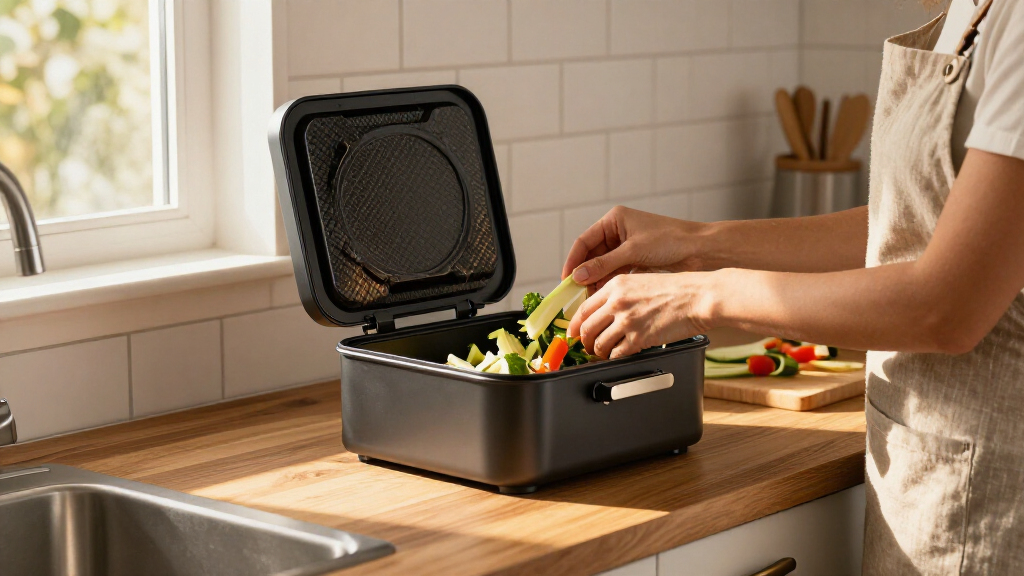
Countertop food waste composters range from electric machines that dry and grind scraps to simple lidded bins that hold them before a trip outside. My best overall pick is the Reencle Prime, whose 14-liter capacity makes it a stronger fit for households that generate a steady stream of scraps. The Food Cycler Eco 5 is a standout for buyers who want a compact electric recycler, while the Epica stainless steel bin suits anyone who wants simple collection without a powered appliance. The main tradeoffs are capacity versus counter space, automation versus upkeep, and electric processing versus basic storage. Read on for the full breakdown and a guide to matching the right style to your kitchen.

Get cleaning gear delivered free with Prime
- Fast, free delivery on millions of items
- Prime Video, Amazon Music and more included
- Member-only deals all year
Complete the kit


Key Takeaways
- Capacity is the clearest divider. The Reencle Prime’s 14-liter chamber stands apart from the mostly 2.5-to-5.5-liter electric models, making it the most natural fit for households that produce scraps often.
- Electric models prioritize convenience, not finished compost. Food Cycler, Ouaken, Saluna, Airthereal, Magnavox, FRYLINE, BEECKYNO, and Growell models process scraps, but buyers should check each maker’s instructions before treating the output as ready-to-use compost.
- Small capacity can be an advantage. The 2.5-liter Airthereal R500 and 3-liter BEECKYNO take less room and may suit singles or occasional cooks better than a larger unit that occupies the counter.
- Simple bins serve a different purpose. Epica and Utopia Kitchen are non-electric collection bins; they avoid processing cycles and appliance maintenance, but do not reduce or process scraps on the counter.
- Feature names do not replace practical checks. A visible window, humidity sensor, or brushless motor may help with monitoring or operation, but lid cleaning, filter replacement, cycle timing, and placement still shape everyday convenience.
| Reencle Prime Electric Kitchen Composter, 14 L, Silver |  | Best for Microbial Composting | Capacity: 14 L | Daily processing capacity: Up to 2.2 lbs of food waste | Decomposition time: 2–24 hours | VIEW LATEST PRICE | See Our Full Breakdown |
| Ouaken 4L Electric Countertop Composter |  | Best for Flexible Modes | Brand: Ouaken | Model: J6001A | Capacity: 4 L | VIEW LATEST PRICE | See Our Full Breakdown |
| Epica Stainless Steel Countertop Compost Bin, 1.3 Gallon, Silver |  | Best Non-Electric Scrap Collector | Capacity: 1.3 gallons | Material: Stainless steel | Color: Silver | VIEW LATEST PRICE | See Our Full Breakdown |
| Saluna 5L Electric Kitchen Composter with Smart Humidity Sensor |  | Best for Sensor-Guided Cycles | Capacity: 5 liters | Dimensions: 9.35 x 12.77 x 16.4 inches | Modes: 4, including auto-cleaning | VIEW LATEST PRICE | See Our Full Breakdown |
| Ouaken OK-255 5.5L Electric Kitchen Composter |  | Best for Multiple Processing Modes | Model: OK-255 | Capacity: 5.5 L | Modes: Standard, Quick, Crush, Clean, Store | VIEW LATEST PRICE | See Our Full Breakdown |
| Food Cycler Eco 5 Electric Kitchen Food Recycler, 5 L, Gray |  | Best for Larger Food-Scrap Loads | Capacity: 5 liters | Dimensions: 10.3 × 13.8 × 13.8 inches | Weight: 13.6 kg | VIEW LATEST PRICE | See Our Full Breakdown |
| Food Cycler Eco 3 Electric Kitchen Food Recycler, 3.5 L, White |  | Best Compact Pick | Capacity: 3.5 L | Dimensions: 11 × 9 × 13 inches | Operation: One-touch button with progress-tracking LEDs | VIEW LATEST PRICE | See Our Full Breakdown |
| Ouaken 4L Electric Kitchen Composter |  | Best for Easy Bucket Cleanup | Capacity: 4 L | Waste reduction: Up to 90% | Processing time: About 3 hours | VIEW LATEST PRICE | See Our Full Breakdown |
| Airthereal R500 Electric Kitchen Composter, 2.5 L, Dark Grey |  | Best for Small, Frequent Batches | Capacity: 2.5 liters | Cycle time: About 4 hours | Waste volume reduction: Up to 90% | VIEW LATEST PRICE | See Our Full Breakdown |
| Saluna 4L Electric Kitchen Composter with Visible Window |  | Best for Monitoring a Cycle | Capacity: 4 liters | Dimensions: 8.99 × 8.99 × 10.12 inches | Controls: LED panel with three modes | VIEW LATEST PRICE | See Our Full Breakdown |
| Magnavox Culinary Chef Series 1-Gallon Smart Electric Food Waste Composter, Stainless Steel |  | Best for Automatic Cycle Adjustment | Capacity: 1 gallon | Material: Stainless steel | Power: 500 W | VIEW LATEST PRICE | See Our Full Breakdown |
| FRYLINE 4L Electric Countertop Food Waste Composter |  | Best for a Short Processing Cycle | Capacity: 4 liters | Dimensions: 16 × 12 × 15 inches | Weight: 18 lb | VIEW LATEST PRICE | See Our Full Breakdown |
| BEECKYNO 3L Electric Countertop Composter |  | Best for Small Kitchens | Capacity: 3 L | Model: HQD-260-Plus | Motor power: 500 W | VIEW LATEST PRICE | See Our Full Breakdown |
| Utopia Kitchen Stainless Steel Countertop Compost Bin, 1.3 Gallon, Silver |  | Best Non-Electric Scrap Bin | Capacity: 1.3 gallons (4.92 liters) | Material and color: Stainless steel, silver | Dimensions: 8.4 × 7 × 11 inches | VIEW LATEST PRICE | See Our Full Breakdown |
| Growell 4L Electric Kitchen Composter with Brushless Motor |  | Best for Flexible Processing Modes | Capacity: 4 L | Model and color: GWEC01BKD, black | Motor: Brushless | VIEW LATEST PRICE | See Our Full Breakdown |
| countertop food waste composter | Capacity | Color | Dimensions | Odor control |
|---|---|---|---|---|
| Reencle Prime Electric Kitchen | 14 L | Silver | — | — |
| Ouaken 4L Electric Countertop | 4 L | White | — | — |
| Epica Stainless Steel Countert | 1.3 gallons | Silver | 7.16 x 7.16 x 11 inches | — |
| Saluna 5L Electric Kitchen Com | 5 liters | White | 9.35 x 12.77 x 16.4 inches | Activated carbon filtration |
| Ouaken OK-255 5.5L Electric Ki | 5.5 L | White | — | Activated-carbon filter |
| Food Cycler Eco 5 Electric Kit | 5 liters | Gray | 10.3 × 13.8 × 13.8 inches | Refillable carbon filter |
| Food Cycler Eco 3 Electric Kit | 3.5 L | White | 11 × 9 × 13 inches | Reusable, refillable carbon filter |
| Ouaken 4L Electric Kitchen Com | 4 L | Black | — | — |
| Airthereal R500 Electric Kitch | 2.5 liters | — | 12.5 × 10 × 12.5 inches | — |
| Saluna 4L Electric Kitchen Com | 4 liters | White | 8.99 × 8.99 × 10.12 inches | Dual activated carbon filters |
| Magnavox Culinary Chef Series | 1 gallon | — | — | Dual activated carbon filters |
| FRYLINE 4L Electric Countertop | 4 liters | — | 16 × 12 × 15 inches | — |
| BEECKYNO 3L Electric Counterto | 3 L | — | — | — |
| Utopia Kitchen Stainless Steel | 1.3 gallons (4.92 liters) | — | 8.4 × 7 × 11 inches | Charcoal filters |
| Growell 4L Electric Kitchen Co | 4 L | — | — | Dual activated-carbon filters and sealed processing design |
More Details on Our Top Picks
Reencle Prime Electric Kitchen Composter, 14 L, Silver
The Reencle Prime takes a different route from countertop units that dry and grind scraps: its microbial, aerobic process is designed to turn food waste into compost rather than simply reduce its volume. Its 14 L capacity and stated daily processing limit of 2.2 pounds suit households that add scraps regularly, while operation as quiet as 28 dB is a plus for an open-plan kitchen. Compared with the Ouaken 4L Electric Countertop Composter, it offers much more capacity and a compost-focused process, but it needs more indoor space and its 2–24-hour processing window is less predictable than a simple volume-reduction claim. The three-layer filter and included starter pack help with setup and odor management, though the daily limit means it is not built for unusually large batches.
Pros:- Microbial aerobic process is designed to produce compost, unlike dryer-grinder units that make dry pre-compost
- 14 L capacity accommodates more collected scraps than the 4 L Ouaken model
- Quiet operation is specified as low as 28 dB
- Includes a carbon filter, compost starter pack, and shovel
Cons:- Daily processing is limited to up to 2.2 pounds of food waste
- Requires dedicated countertop or other indoor space
- Processing time ranges from 2 to 24 hours
Best for: Households that add food scraps daily and want a higher-capacity microbial countertop composter rather than a dryer-grinder
Not ideal for: People with limited counter or indoor space, or households that regularly need to process more than 2.2 pounds of scraps per day
- Capacity:14 L
- Daily processing capacity:Up to 2.2 lbs of food waste
- Decomposition time:2–24 hours
- Noise level:As low as 28 dB
- Filtration:Three-layer filter system
- Included accessories:Carbon filter, compost starter pack, and shovel
- Color:Silver
- Use:Indoor, countertop
Our verdict“Choose the Reencle Prime if you want a larger-capacity microbial composter and have room for it indoors.”
Ouaken 4L Electric Countertop Composter
The Ouaken 4L suits buyers who want a straightforward electric unit with separate Crush, Ferment, and Clean modes. Its high-temperature drying and grinding reduce waste volume by up to 90% within hours, so it is better understood as a volume reducer than as a machine that produces finished compost. The detachable, dishwasher-safe bucket makes cleanup easier than a fixed chamber, and the carbon filter is specified to last up to five months. Compared with the larger Saluna 5L Electric Kitchen Composter, this model takes less capacity, but its cleaning-friendly bucket and clearly defined modes make routine operation appealing. The main catch is the need to empty the bucket between cycles to limit clumping; repeated processing can also cause fan or blade malfunctions, so it is a poor fit for nonstop batch use.
Pros:- Crush, Ferment, and Clean modes provide distinct operating options
- Reduces food waste volume by up to 90% within hours
- Detachable bucket is dishwasher safe
- Carbon filter life is specified as up to five months
Cons:- Bucket should be emptied between cycles to help prevent clumping
- Repeated processing can cause fan or blade malfunctions
- Produces reduced, dried waste rather than guaranteed finished compost
Best for: Small households seeking a compact dryer-grinder with separate processing and cleaning modes and a removable, dishwasher-safe bucket
Not ideal for: People who want finished compost, need to process successive large batches, or do not want to empty the bucket between cycles
- Brand:Ouaken
- Model:J6001A
- Capacity:4 L
- Modes:Crush, Ferment, Clean
- Waste reduction:Up to 90%
- Noise level:Below 40 dBA
- Carbon filter life:Up to 5 months
- Bucket:Detachable and dishwasher safe
- Color:White
Our verdict“Pick the Ouaken 4L if you want multiple modes and easy bucket cleanup in a smaller-capacity dryer-grinder.”
Epica Stainless Steel Countertop Compost Bin, 1.3 Gallon, Silver
The Epica 1.3-gallon bin is the simplest option here: it collects scraps on the counter but does not dry, grind, or compost them. That distinction makes it a sensible choice for buyers who already have a composting routine and want a contained place to gather scraps between trips to an outdoor bin or community drop-off. Its airtight, leak-resistant lid and replaceable activated-charcoal filter help manage kitchen odors without a powered cycle. Compared with the Reencle Prime, Epica needs no electrical operation and has a smaller footprint, but it offers no processing and requires regular emptying and hand-washing. The stainless-steel, one-piece body resists rust and leaks; the filter still needs care or replacement every three to six months, adding a recurring maintenance task.
Pros:- Airtight, leak-resistant lid and charcoal filter help limit odors
- One-piece stainless-steel construction resists rust and leaks
- Compact 1.3-gallon capacity fits countertop scrap collection
- No electrical cycle or powered components are required
Cons:- Does not process scraps or reduce their volume
- Needs regular emptying and hand-washing for best results
- Charcoal filter requires rinsing or replacement every 3–6 months
Best for: Apartment cooks and established composters who need a compact, odor-conscious countertop container for collecting scraps
Not ideal for: Buyers expecting an electric composter to reduce waste volume or process scraps on the counter
- Capacity:1.3 gallons
- Material:Stainless steel
- Color:Silver
- Dimensions:7.16 x 7.16 x 11 inches
- Lid:Airtight and leak-resistant
- Filter:Replaceable activated-charcoal filter
- Filter lifespan:3–6 months with regular use and proper care
- Cleaning:Hand-wash with warm water
Our verdict“Choose Epica if you want a durable countertop collection bin, not an appliance that processes food waste.”
Saluna 5L Electric Kitchen Composter with Smart Humidity Sensor
The Saluna 5L is a dryer-grinder for buyers who want some cycle management without handling settings for every load. Its smart humidity sensor helps optimize cycles, while four modes—including auto-cleaning—give it more built-in flexibility than the simpler three-mode Ouaken 4L. The 5-liter removable bucket is dishwasher safe, which can make cleanup less of a chore after drying scraps. Its stated reduction of up to 90% helps shrink what goes into the next waste or composting step, but the output is dry pre-compost, not finished compost; buyers still need an appropriate way to use or dispose of it. Compared with the larger-capacity Reencle Prime, Saluna uses a drying-and-blade process and has less capacity, so it suits routine household scraps better than large-volume processing.
Pros:- Humidity sensor helps optimize processing cycles
- Four modes include an auto-cleaning option
- Removable bucket is dishwasher safe
- Reduces food waste volume by up to 90%
Cons:- Produces dry pre-compost rather than finished compost
- The 5-liter capacity can limit how much waste is collected at once
- Its rectangular body needs dedicated countertop space
Best for: Home cooks who want a mid-size electric dryer-grinder with sensor-guided cycles, multiple modes, and dishwasher-safe cleanup
Not ideal for: Buyers seeking finished compost directly from the appliance or a large-capacity system for heavy food-waste volumes
- Capacity:5 liters
- Dimensions:9.35 x 12.77 x 16.4 inches
- Modes:4, including auto-cleaning
- Odor control:Activated carbon filtration
- Bucket:Removable and dishwasher-safe
- Waste reduction:Up to 90%
- Color:White
- Material:Metal and stainless steel
Our verdict“Pick the Saluna if sensor-guided drying and easier bucket cleanup matter more than finished compost or high capacity.”
Ouaken OK-255 5.5L Electric Kitchen Composter
The Ouaken OK-255 offers the most modes among these five picks, with Standard, Quick, Crush, Clean, and Store settings for different stages of everyday handling. Its 5.5-liter chamber is slightly larger than the Saluna 5L, and both use drying and grinding to reduce waste volume by up to 90%; neither should be mistaken for a machine that delivers finished compost. The transparent flip-top lid lets users check the chamber without opening it, while the non-stick interior and detachable fan module address cleanup and maintenance access. Activated-carbon filtration and airflow are intended to manage odors, but the unit still occupies counter space despite its flatter oval profile. Its filter needs replacement about every five months, and operation below 45 dBA is not as quiet as the Reencle Prime’s stated 28 dB.
Pros:- Five modes cover standard, quick, crushing, cleaning, and storage needs
- 5.5 L capacity is larger than the Saluna 5L
- Transparent flip-top lid and detachable fan module support access and maintenance
- Activated-carbon filtration and airflow help control odors
Cons:- Reduces and dries scraps rather than producing finished compost
- Filter replacement is recommended approximately every five months
- Below 45 dBA is louder than the Reencle Prime’s stated minimum of 28 dB
Best for: Households that want several cycle choices, a little more chamber capacity than a 5-liter unit, and accessible maintenance features
Not ideal for: Noise-sensitive kitchens or buyers who want finished compost, a compact appliance, or minimal filter upkeep
- Model:OK-255
- Capacity:5.5 L
- Modes:Standard, Quick, Crush, Clean, Store
- Waste volume reduction:Up to 90%
- Noise level:Below 45 dBA
- Odor control:Activated-carbon filter
- Recommended filter replacement interval:Approximately 5 months
- Coating hardness:9H
- Color:White
Our verdict“Choose the OK-255 if you value varied cycle settings and accessible maintenance more than quiet operation or finished compost.”
Food Cycler Eco 5 Electric Kitchen Food Recycler, 5 L, Gray
The 5-liter removable bucket gives the Eco 5 more room per batch than the 3.5-liter Food Cycler Eco 3 and the 2.5-liter Airthereal R500, making it a better fit for kitchens that collect scraps throughout the day. Its Vortech grinding system is described as handling pits, peels, and bones, so it can accommodate a broader mix of scraps than a unit suited mainly to everyday trimmings. A refillable carbon filter helps manage odors while the one-touch control keeps operation straightforward. The tradeoff is its larger footprint: at 13.8 inches wide and deep, it needs more counter space than the Eco 3. The bucket can still fill quickly in a high-volume household, and the filter requires refilling. Like other electric recyclers here, it reduces waste volume rather than producing finished compost.
Pros:- 5-liter removable bucket offers more batch capacity than the Food Cycler Eco 3 and Airthereal R500.
- Vortech system is described as handling pits, peels, and bones.
- Refillable carbon filter helps absorb odors during processing.
- One-touch control keeps operation simple.
Cons:- The 13.8-inch width and depth take up notable counter space.
- The 5-liter bucket may need frequent emptying in high-volume kitchens.
- The carbon filter requires refilling.
Best for: Households that generate a steady, varied mix of kitchen scraps and want a larger removable bucket with simple controls.
Not ideal for: Small kitchens or high-volume households expecting a large-capacity appliance; its 5-liter bucket still needs emptying, and its footprint is substantial.
- Capacity:5 liters
- Dimensions:10.3 × 13.8 × 13.8 inches
- Weight:13.6 kg
- Grinding system:Vortech
- Odor control:Refillable carbon filter
- Color:Gray
- Material:Plastic
- Warranty:3-year limited
Our verdict“Choose the Eco 5 if you want a larger batch capacity and broad scrap handling, and have room for its countertop footprint.”
Food Cycler Eco 3 Electric Kitchen Food Recycler, 3.5 L, White
The Eco 3 is the more space-conscious Food Cycler in this group: its 3.5-liter capacity and 9-inch width make it easier to place than the larger Eco 5. A removable bucket can sit near the prep area, then return to the unit for processing, while progress-tracking LEDs show cycle status without adding complicated controls. Its reusable, refillable carbon filter is designed to control odors. Compared with the Ouaken 4L, the Eco 3 gives up some capacity and does not list a dishwasher-safe bucket or multiple modes, but its compact dimensions and one-touch operation may suit buyers who favor a simpler routine. It still occupies counter or cupboard space, and the filter needs attention over time; compact does not mean negligible in a crowded kitchen.
Pros:- 9-inch width makes it narrower than the Food Cycler Eco 5.
- Removable bucket can be placed near food-preparation areas.
- One-touch operation and progress LEDs make cycle status easy to follow.
- Reusable, refillable carbon filter is designed to control odors.
Cons:- 3.5-liter capacity is smaller than the Eco 5 and the 4-liter Ouaken and Saluna models.
- Refillable carbon filter requires upkeep.
- Still takes up counter or cupboard space despite its compact dimensions.
Best for: Apartment cooks or small households who want a relatively narrow countertop recycler, a removable bucket, and straightforward operation.
Not ideal for: Families producing larger daily scrap loads or buyers who want a dishwasher-safe bucket and multiple cycle modes.
- Capacity:3.5 L
- Dimensions:11 × 9 × 13 inches
- Operation:One-touch button with progress-tracking LEDs
- Grinding system:Vortech
- Odor control:Reusable, refillable carbon filter
- Bucket:Removable
- Color:White
Our verdict“Pick the Eco 3 for a smaller kitchen and simple controls, but choose a 4- or 5-liter model if batch capacity matters more.”
Ouaken 4L Electric Kitchen Composter
The Ouaken’s clearest advantage over the Food Cycler Eco 3 is its detachable, dishwasher-safe bucket, which makes routine cleanup less dependent on hand-washing. Its 4-liter capacity also edges past the Eco 3’s 3.5 liters, while the listed Crush, Ferment, and Clean modes offer more operating choices than the Eco 3’s one-touch setup. The product description states that it reduces volume by up to 90% in about three hours, and its carbon filter is rated for up to five months. That filter lifespan means upkeep is part of ownership, not a one-time task. The 4-liter chamber may still feel small for a busy family, and the available information does not list dimensions, so buyers cannot compare its counter footprint as precisely as they can with the Saluna 4L.
Pros:- Detachable bucket is dishwasher safe for simpler cleanup.
- Crush, Ferment, and Clean modes provide more choices than the Food Cycler Eco 3.
- Listed processing time is about three hours.
- Carbon filter is described as lasting up to five months.
Cons:- Four-liter capacity may be limiting for households with larger scrap loads.
- Carbon filter replacement or upkeep is needed after its stated service life.
- Dimensions are not provided in the supplied product data.
Best for: Cooks who want a 4-liter electric recycler with a dishwasher-safe bucket and an included cleaning mode.
Not ideal for: Large households with heavy daily scrap loads or buyers who need verified dimensions before planning a tight countertop layout.
- Capacity:4 L
- Waste reduction:Up to 90%
- Processing time:About 3 hours
- Noise level:Below 40 dBA
- Modes:Crush, Ferment, Clean
- Carbon filter life:Up to 5 months
- Bucket:Detachable and dishwasher safe
- Color:Black
Our verdict“Choose the Ouaken if dishwasher-safe cleanup and multiple modes matter more than a larger capacity or fully specified footprint.”
Airthereal R500 Electric Kitchen Composter, 2.5 L, Dark Grey
With a 2.5-liter capacity, the Airthereal R500 is the smallest-batch option in this set, well below the Food Cycler Eco 5’s 5 liters and the 4-liter Ouaken. That makes it a more sensible match for one or two people who produce modest amounts of scraps and prefer to process them regularly rather than save a larger load. Its cast-aluminum, dishwasher-safe bucket offers a distinct cleanup advantage over the Eco 5’s plastic bucket, and the SHARKSDEN tri-blade is designed to crush scraps from multiple directions. The stated cycle takes about four hours, so it is slower than the Ouaken’s listed three-hour process and calls for some planning. At 16.8 pounds, it is also not especially light to move, despite its smaller capacity.
Pros:- Dishwasher-safe cast-aluminum bucket simplifies cleanup.
- SHARKSDEN tri-blade is designed to crush scraps from multiple directions.
- One-button operation keeps the control scheme simple.
- Carbon filters help reduce odors between cycles.
Cons:- 2.5-liter capacity is the smallest among these five products.
- The stated four-hour cycle is longer than the Ouaken’s listed processing time.
- At 16.8 pounds, it may be awkward to relocate.
Best for: One- or two-person households that generate modest scraps and value a dishwasher-safe metal bucket.
Not ideal for: Families or batch-oriented cooks who want higher capacity, a shorter stated cycle, or an appliance that is easy to move.
- Capacity:2.5 liters
- Cycle time:About 4 hours
- Waste volume reduction:Up to 90%
- Blade design:SHARKSDEN tri-blade
- Bucket material:Cast aluminum
- Bucket cleaning:Dishwasher safe
- Dimensions:12.5 × 10 × 12.5 inches
- Weight:16.8 lbs
Our verdict“The R500 suits small households that prioritize a dishwasher-safe metal bucket over capacity and a shorter cycle.”
Saluna 4L Electric Kitchen Composter with Visible Window
The Saluna’s viewing window sets it apart from the Ouaken 4L: you can check progress without opening the lid. Its 4-liter capacity matches the Ouaken and exceeds the Airthereal R500’s 2.5 liters, while an LED panel with three modes gives more control than the Food Cycler Eco 3’s one-touch operation. Cleanup is another strength: the removable bucket is dishwasher safe, and one-touch auto-cleaning adds a second route for routine maintenance. Dual activated carbon filters are intended to control odors. The tradeoff is that the 4-liter chamber may not suit households generating a large volume of scraps, and the material output is described as dry pre-compost, not finished compost. Its compact listed dimensions help with placement, but the supplied data does not include a processing time.
Pros:- Viewing window allows progress checks without opening the lid.
- Three modes offer more control than the Food Cycler Eco 3’s one-touch setup.
- Removable dishwasher-safe bucket and one-touch auto-cleaning simplify cleanup.
- Dual activated carbon filters help control odors.
Cons:- Four-liter capacity may be limited for larger households.
- Produces dry pre-compost rather than finished compost.
- Processing time is not listed in the supplied product data.
Best for: Kitchen users who want to monitor progress through a window and prefer multiple modes with dishwasher-safe cleanup.
Not ideal for: Buyers who need a large batch capacity, a stated cycle duration, or a unit that produces finished compost.
- Capacity:4 liters
- Dimensions:8.99 × 8.99 × 10.12 inches
- Controls:LED panel with three modes
- Cleaning:One-touch auto-cleaning; removable dishwasher-safe bucket
- Odor control:Dual activated carbon filters
- Material:Metal, stainless steel
- Color:White
- Model number:FC-385W
Our verdict“Choose the Saluna if visibility and convenient cleaning matter most, and a 4-liter batch is enough for your kitchen.”
Magnavox Culinary Chef Series 1-Gallon Smart Electric Food Waste Composter, Stainless Steel
The Magnavox Culinary Chef Series stands out for buyers who want a larger countertop load handled with less guesswork. Its auto-weighing feature adjusts processing time to the amount of scraps, unlike the FRYLINE 4L, which offers three modes but does not list weight-based cycle adjustment. A 1-gallon capacity and 4–6-hour automatic cycle suit regular kitchen use, while the touchscreen and manual settings give more control when needed.
The tradeoff is that flexibility adds a little setup: manual cycles must be set from 1 to 6 hours. Dual carbon filters and a removable non-stick bucket support odor management and cleanup, but the output is described as plant-friendly fertilizer rather than finished compost. Choose it for adaptive processing, not a ready-to-use compost result.
Pros:- Auto-weighing adjusts cycle time to the amount of food waste.
- One-gallon capacity accommodates a substantial countertop load.
- Dual activated carbon filters help manage odors during processing.
- Removable non-stick bucket and detachable blades support easier cleaning.
Cons:- Manual cycles require users to choose a duration between 1 and 6 hours.
- Processed material is described as plant-friendly fertilizer, not finished compost.
Best for: Households that produce regular food scraps and want cycle length adjusted automatically to the load.
Not ideal for: Buyers who need finished compost straight from the machine or prefer not to set manual cycle times.
- Capacity:1 gallon
- Material:Stainless steel
- Power:500 W
- Automatic cycle:4–6 hours
- Manual cycle:1–6 hours
- Waste volume reduction:Up to 90%
- Odor control:Dual activated carbon filters
- Controls and features:Digital touchscreen, auto-weighing, removable non-stick bucket, detachable blades
Our verdict“Pick the Magnavox if you want a one-gallon electric composter that automatically adapts its cycle to the load.”
FRYLINE 4L Electric Countertop Food Waste Composter
The FRYLINE 4L is the speed-focused choice in this group: its high-temperature drying, grinding, and cooling cycle reduces scraps by up to 90% in about three hours. That is shorter than the Magnavox Culinary Chef Series’ stated 4–6-hour automatic cycle, making FRYLINE a better fit for kitchens that want a quicker routine between meal prep and emptying. Its Crush, Ferment, and Clean modes also cover more than basic reduction, and the transparent lid lets you check the contents without opening the unit.
The 4-liter capacity is smaller than the Magnavox’s one-gallon load, so households with heavy scrap output may need to run it more often. The dishwasher-safe bucket eases cleanup, but the carbon filter is rated for 1,000 hours and needs replacement. Its 18-pound body and 16 × 12 × 15-inch footprint also claim meaningful counter space.
Pros:- Processes food waste in about three hours.
- Three modes cover crushing, fermentation, and cleaning.
- Detachable bucket is dishwasher-safe.
- Carbon filter includes an alert when replacement is due.
Cons:- Four-liter capacity may require frequent cycles for households with substantial scraps.
- Its 16 × 12 × 15-inch footprint and 18-pound weight make it less convenient for tight counters.
- Carbon filter replacement is needed after 1,000 hours of use.
Best for: Small households that want a relatively quick processing cycle and a dishwasher-safe removable bucket.
Not ideal for: Large households with high daily scrap volume or kitchens with limited counter space.
- Capacity:4 liters
- Dimensions:16 × 12 × 15 inches
- Weight:18 lb
- Material and color:Metal, white
- Modes:Crush, Ferment, Clean
- Processing and reduction:Up to 90% in about 3 hours
- Noise level:Below 40 dBA
- Filter and bucket:Carbon filter rated for 1,000 hours; detachable dishwasher-safe bucket
Our verdict“Choose FRYLINE if a roughly three-hour cycle and easy bucket cleanup matter more than a larger capacity or compact footprint.”
BEECKYNO 3L Electric Countertop Composter
With a 3-liter capacity, the BEECKYNO is the most compact electric option among these five, making it a better match for modest scrap volumes than the four-liter FRYLINE or Growell. It dries and grinds scraps into pre-compost, reducing volume by up to 90%, while its below-40 dB operation is suited to kitchens where a louder appliance would be distracting. A visible window and one-touch modes keep routine operation simple.
Its storage mode holds scraps for up to 12 hours, giving users some flexibility between meals and a processing cycle. That limit is shorter than an open-ended storage solution, so it still calls for a regular routine. The non-stick, dishwasher-safe bucket and automatic cleaning mode reduce maintenance, though the carbon filter needs replacement every 2–3 months. This is a small-footprint pick, not the best choice for a family-sized scrap load.
Pros:- Compact 3-liter capacity suits small households and limited counter space.
- Operates below 40 dB and reduces waste volume by up to 90%.
- Storage mode and carbon filtration help manage scraps and odors between cycles.
- Non-stick dishwasher-safe bucket and automatic cleaning mode simplify upkeep.
Cons:- Storage mode is limited to a maximum of 12 hours.
- Carbon filter replacement is recommended every 2–3 months.
- Its 3-liter capacity is less suited to high-volume households than the FRYLINE or Growell.
Best for: Singles, couples, or small-kitchen cooks who want a quiet electric unit with a modest capacity and simple controls.
Not ideal for: Families producing large daily volumes of scraps or buyers who need to store waste longer than 12 hours before processing.
- Capacity:3 L
- Model:HQD-260-Plus
- Motor power:500 W
- Noise level:Below 40 dB
- Waste volume reduction:Up to 90%
- Storage duration:Up to 12 hours
- Bucket:Cast aluminum with double-layer nano-ceramic coating; dishwasher-safe
- Modes and filter:Drying, storage, and self-cleaning modes; carbon filter life 2–3 months
Our verdict“Choose the BEECKYNO for a quieter, compact electric composter if your household produces modest scraps and can process them within 12 hours.”
Utopia Kitchen Stainless Steel Countertop Compost Bin, 1.3 Gallon, Silver
Unlike the Magnavox, FRYLINE, BEECKYNO, and Growell, the Utopia Kitchen bin is not an electric food recycler: it stores scraps rather than drying or grinding them. That distinction makes it a straightforward choice for people who already compost elsewhere and want a countertop collection point without a powered processing cycle. Its 1.3-gallon capacity is larger than the Magnavox’s one-gallon stated capacity, and the stainless-steel body offers a simple, durable alternative to a motorized appliance.
A lid with charcoal filters helps contain odors, and the compact 8.4 × 7 × 11-inch shape can sit on a counter. The tradeoff is that scraps remain wet and unprocessed, so moisture management matters: the product recommends draining excess liquid and lining the base with newspaper or cardboard. Choose this for collecting scraps, not for reducing their volume or producing pre-compost at home.
Pros:- 1.3-gallon capacity holds scraps for later composting or collection.
- Stainless-steel construction resists scratching, cracking, and chipping.
- Charcoal filters in the lid help control odors.
- Lightweight cylindrical form is easy to move and clean.
Cons:- Does not process scraps or reduce their volume like the electric models in this roundup.
- Excess moisture must be drained, and the base may need newspaper or cardboard to absorb liquid.
Best for: People who compost outdoors or use a separate collection service and want a simple, non-electric countertop scrap container.
Not ideal for: Buyers seeking an appliance that dries, grinds, or reduces food-scrap volume on the counter.
- Capacity:1.3 gallons (4.92 liters)
- Material and color:Stainless steel, silver
- Dimensions:8.4 × 7 × 11 inches
- Weight:2 pounds
- Shape:Cylindrical
- Odor control:Charcoal filters
- Cleaning:Rinse with water, mild soap, or vinegar
- Model:CB-13
Our verdict“Pick this bin if you need a durable countertop collection container rather than an electric composter.”
Growell 4L Electric Kitchen Composter with Brushless Motor
The Growell 4L suits buyers who want to choose between automatic, manual, and fermentation processing rather than relying on a single routine. Its auto cycle runs 4–6 hours, while the manual setting allows 1–6 hours and a separate 10-hour fermentation mode offers another step for handling the dried output. Compared with the FRYLINE 4L, which lists a roughly three-hour cycle, Growell takes longer but gives users more control over processing stages.
A brushless motor, sealed design, dual activated-carbon filters, and progress display make this a feature-rich countertop option. The visible window and remaining-time readout help users track a cycle without opening the lid. Its main limitation is the result: dried material is not finished compost and may need further processing before use around plants. Filter condition and food type can also affect odor control, with replacement recommended about every three months.
Pros:- Four-liter capacity suits everyday household food scraps.
- Automatic, adjustable manual, and separate fermentation modes offer processing flexibility.
- Dual carbon filters and a sealed design help manage indoor odors.
- Brushless motor and progress display support quieter wear characteristics and clear cycle monitoring.
Cons:- Automatic cycles take 4–6 hours, while manual cycles run from 1–6 hours.
- Dried output may need further fermentation and processing before plant or soil use.
- Filters are recommended for replacement about every three months, and odor control varies with load and filter condition.
Best for: Households that want a four-liter electric recycler with adjustable cycle settings, a fermentation mode, and visible progress tracking.
Not ideal for: Buyers seeking a quick three-hour cycle or finished compost ready to use directly in soil or around plants.
- Capacity:4 L
- Model and color:GWEC01BKD, black
- Motor:Brushless
- Processing modes:Auto (4–6 hours), manual (1–6 hours), fermentation (10 hours)
- Waste volume reduction:Up to 90%
- Odor control:Dual activated-carbon filters and sealed processing design
- Controls and monitoring:LED touch panel, visible window, remaining-time display
- Warranty:3 years
Our verdict“Choose Growell if you value multiple processing modes and cycle visibility more than speed or ready-to-use compost.”
How We Picked
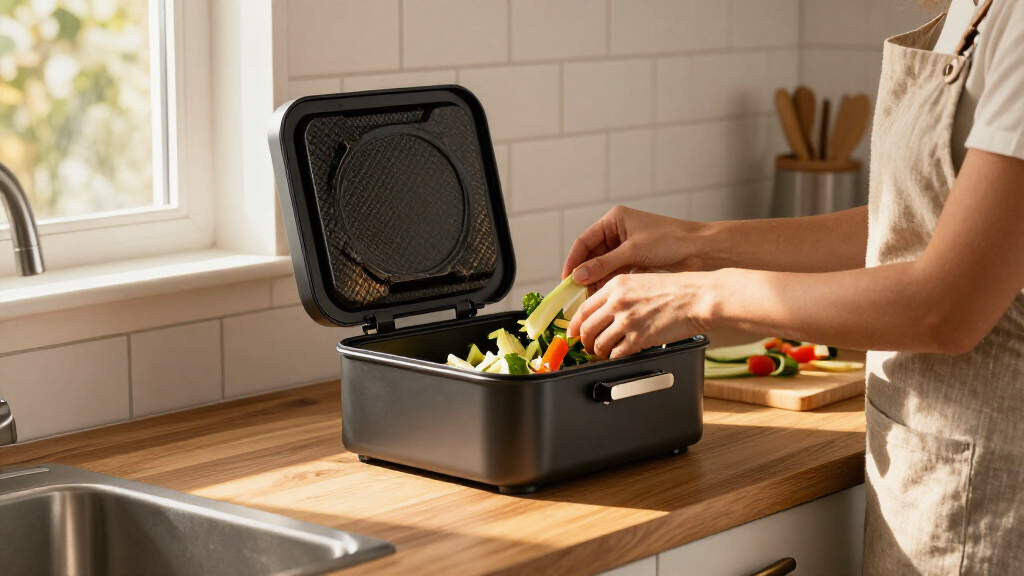
I compared these products as countertop food-waste solutions, not as interchangeable composters. The ranking weighs capacity against footprint, the kind of work each product actually does, likely day-to-day effort, and whether its features address a real kitchen need. Electric processing units rank ahead of passive bins for buyers seeking on-counter waste reduction, while the bins remain relevant for shoppers who only need contained collection.
Within the electric group, I gave more weight to a useful capacity and clear household fit than to feature claims alone. The Reencle Prime ranks first for its unusually large stated capacity; Food Cycler Eco 5 follows as a more compact electric option. Smaller machines and models with specialized features suit narrower needs, while basic collection bins rank lower for processing because they do not treat scraps. I also factor in tradeoffs: larger chambers claim more space, smaller units need more frequent attention, and powered models bring cycles and maintenance that a simple bin avoids.
Factors to Consider When Choosing Countertop Food Waste Composters
Before choosing a model, decide what job you want it to do. A countertop unit may collect scraps, reduce their volume, or process them through a powered cycle; those are different outcomes, even when product names use similar language. These broader checks can help prevent a mismatch between the machine you buy and the routine you can sustain.
Choose the Job Before the Appliance
Start by deciding whether you need a container for gathering scraps or an appliance that processes them. A passive bin such as the Epica or Utopia Kitchen holds waste until you empty it, while an electric unit adds a powered processing step. Do not assume that dried or ground material is finished compost or can go directly onto plants; follow the manufacturer’s directions and your local composting rules. If you already have a municipal food-scrap collection or backyard pile, a simple bin may be enough. Paying for an electric cycle makes more sense when reducing the volume of scraps at home is part of your routine. This distinction matters more than a product’s use of the word “composter.”
Match Capacity to Your Scrap Rhythm
Capacity should reflect how often you cook, how much produce you prepare, and how often you are willing to run or empty the unit. A larger chamber can reduce the number of trips to empty it, but it also claims more counter space and may invite you to let scraps accumulate. Compact models are easier to place in a small kitchen, yet frequent cooks may find themselves running cycles or emptying them often. Think about a typical week rather than a single large meal when estimating your needs. Also check whether the stated capacity refers to the chamber’s volume or a practical load, since scraps vary in density and moisture. A little spare capacity is useful, but buying the largest machine by default can create a footprint problem.
Plan for Moisture, Odor, and Filter Care
Food scraps contain water, and wet or strongly scented ingredients can make storage and processing less pleasant. A lid, filter, or humidity-related feature may help manage the routine, but it does not remove the need for cleaning and following load instructions. Ask how filters are replaced, whether replacement parts are readily available, and which surfaces can be washed. A common mistake is to focus on odor claims while overlooking the recurring work of wiping the chamber and lid. If you expect to process fish, meat, or very wet scraps, check the maker’s accepted-material list rather than assuming every food waste item is suitable. The easier the upkeep fits your habits, the more likely the appliance is to stay in use.
Measure the Counter and Check the Setup
Measure the spot where the unit will sit, including clearance above it and space for opening the lid or removing the inner bucket. Consider nearby outlets, ventilation guidance, and whether the appliance can remain on the counter during a cycle. A model with a viewing window can make it easier to see what is happening, but that feature does not compensate for a poor fit or awkward access. Check the product’s dimensions and operating instructions before ordering, especially if upper cabinets sit close to the counter. A compact machine may be a better daily fit than a larger-capacity option if it can remain accessible. The best footprint is the one your kitchen can accommodate without turning loading and emptying into a chore.
Compare Convenience Features With Recurring Work
Sensors, cycle controls, and motor designs can distinguish electric models, but each feature is useful only if it simplifies a task you actually perform. A humidity sensor may help a machine respond to changing conditions, while a visible window may let you check progress without opening the lid. Neither feature removes the need to sort scraps, clean the chamber, or manage the output. Before paying for added controls, look for clear information about cycle length, noise, energy use, filter life, and cleaning steps. These details are often more relevant to everyday satisfaction than a longer list of modes. If you prefer minimal intervention, compare the full routine rather than the feature count.
Know What Happens to the Output
Buying a countertop processor does not automatically close the loop on food waste. Find out how the manufacturer says to handle the processed material, whether it needs further composting, and what disposal options your local program accepts. Some households have a garden or community compost site ready to receive it; others may have no practical place to use the output. In that case, a collection bin paired with municipal pickup could be more useful than an electric unit. Avoid choosing a machine solely because its output appears dry or reduced in volume. The right choice depends on having a realistic next step after the cycle ends.
Frequently Asked Questions
Does a countertop electric composter make finished compost?
Not necessarily. Many countertop electric units dry, grind, or otherwise reduce food scraps, but that output may still need further composting before it is suitable for garden use. Check the instructions for the exact model and confirm what materials it accepts. Also consider where the output will go before buying: a home compost pile, community site, or approved waste program may be needed. A smaller volume does not by itself mean the scraps have become finished compost.
Should I choose the Reencle Prime’s larger capacity or a smaller 4-to-5-liter model?
Choose based on how much food waste you generate and how much counter space you can give up. The Reencle Prime’s stated 14-liter capacity can make sense for a busy household that wants fewer interruptions, while the smaller Ouaken, Saluna, and Food Cycler options suit kitchens where footprint matters more. A large chamber is not automatically better if it sits unused or crowds the work surface. Estimate your weekly scraps and compare that with the maker’s guidance on practical loads. If you cook in batches, capacity may matter more than it does for a household that produces scraps gradually.
Are the Epica and Utopia Kitchen bins alternatives to electric composters?
They are alternatives for collecting scraps, not for processing them on the counter. Both are stainless steel bins with a 1.3-gallon capacity, so they serve shoppers who want a straightforward place to hold food waste before taking it elsewhere. They avoid powered cycles and appliance components, but they do not reduce scraps or turn them into compost. Choose one if you already have a convenient composting or collection routine. If your main goal is on-counter processing, compare electric models instead.
How much maintenance should I expect from an electric countertop composter?
Expect some combination of unloading processed material, cleaning the chamber and lid, and maintaining or replacing any filter the model uses. The exact routine varies by product, so check the care instructions and ongoing parts requirements before choosing. Moist or sticky scraps can make cleanup more involved, and leaving material in a unit longer than directed may affect odor. Features such as a sensor or window can support operation, but they do not eliminate cleaning. A model that fits your willingness to maintain it is a better choice than one selected only for its capacity.
Can I put meat, dairy, or oily leftovers in these machines?
Do not assume all countertop machines accept the same scraps. Each manufacturer may set different limits for meat, dairy, oils, bones, or very wet foods, and those limits can affect odor, processing, and maintenance. Read the accepted-material list for the specific model before loading it, and follow any directions about portion size or preparation. If your household relies heavily on scraps that a machine excludes, its advertised capacity may not reflect how useful it will be to you. A simple collection bin paired with an appropriate composting service may be a better fit.
Conclusion
For a household that wants the most room to collect scraps in an electric countertop unit, I recommend the Reencle Prime as best overall. The Food Cycler Eco 5 is my best value-style pick for a compact electric setup, while the Reencle is also the best premium choice for buyers who prioritize a larger stated capacity. For beginners who want the simplest routine, the Epica stainless steel bin offers straightforward collection without a processing cycle; choose it only if you already have a place to take the scraps. For a small kitchen or lighter scrap output, compare the Airthereal R500 and BEECKYNO 3L compact models. If you want a particular feature, the Saluna with its visible window or humidity sensor and the Growell with its brushless motor may be worth comparing, but check their care instructions and dimensions before deciding. The right pick is the one whose capacity, footprint, upkeep, and output-handling routine match how your household actually deals with food waste.